
Access to San Diego Public Records
California's Public Records Act, Government Code section 7920.000 and following, opens writings that San Diego and other state and local agencies prepare, own, use, or retain in public business. That broad rule does not make every government-held fact open. Statutes and court rules restrict certain vital, voter, juvenile, sealed, and investigative material. San Diego court files also follow judicial access rules rather than the same agency request process.
| San Diego record set | Custodian | Online coverage | How access works |
|---|---|---|---|
| Deeds, liens, maps | San Diego County ARCC Recorder | Official Records Index, 1970 to present | Free index; mailed copies or kiosk images |
| Property assessment | San Diego County ARCC Assessor | Current ParcelQuest Lite data | Free within use limits; paid reports may apply |
| Court cases | San Diego Superior Court | Index and Registers of Actions | Index online; official files at clerk or by request |
| Birth, death, marriage | ARCC, San Diego County HHSA, CDPH | No open current certificate index | Authorized or informational copy rules |
| City permits and files | San Diego city departments and Clerk | Permits from 2003; prior requests online | Portal, records counter, or CPRA request |
| Current jail custody | San Diego County Sheriff | Who's In Jail | Web lookup with phone fallback |
A San Diego online result is often an index, not the official instrument. The distinction matters when confirming a transfer, reading a court outcome, or obtaining a certified certificate. Use the portal to identify the item, then follow the custodian's copy channel.
Custody and safety records have their own routes. The San Diego Sheriff's Who's In Jail tool covers current county custody, with 858-974-2222 as a phone fallback when the dynamic search cannot be reached. California's CIRIS searches state prisoners by name or CDCR number. The federal Bureau of Prisons has a separate inmate locator, and California's Megan's Law registry is the official public offender search. Each source covers a different system, so a missing name in one does not resolve the others.
San Diego Recorder Records Online
The San Diego County Assessor/Recorder/County Clerk, often called ARCC, preserves and indexes recorded real-property documents. Its Official Records Index covers 1970 to the present. Searchers use a grantor or grantee name, meaning the party transferring an interest or the party receiving one. Recent recordings may take 24 to 48 hours to appear.
| Recorder field | Use | Access note |
|---|---|---|
| Grantor or grantee | Find a party to a recorded document | Search either side of the transfer |
| Document number | Identify a filing for a copy order | Include it in a mailed request when known |
| Recording year | Narrow the copy search | Mail orders ask for the recorded year |
| Document type | Separate deeds, liens, notices, and maps | Include the type in a mailed request |
| APN | Parcel-based document search | Kiosk only since December 9, 2024 |
The San Diego web index shows indexed facts, not document images. An online order is printed the next business day and mailed by USPS; ARCC does not send purchased copies by email, online delivery, or fax. A written request may instead list the document number, year, one party name, and document type. Public kiosks provide the strongest fallback because they support document viewing and the APN search removed from the web under AB 1785.
Note: For deeds recorded before 1970, contact ARCC or historical repositories instead of assuming the online index is complete.
San Diego Court Records Layers
San Diego Superior Court separates locating a case from reading the official file. The Court Index searches civil, criminal, domestic, mental health, and probate matters by party name, case number, or district attorney number. The index can return a case number and filing location, but it does not show charges or disposition, which means the final outcome. A case can remain in the index even after dismissal with no finding of guilt or responsibility.
The San Diego court party-name search exposes the controls shown below. The form helps distinguish common names by court division, party role, filing years, and date of birth.
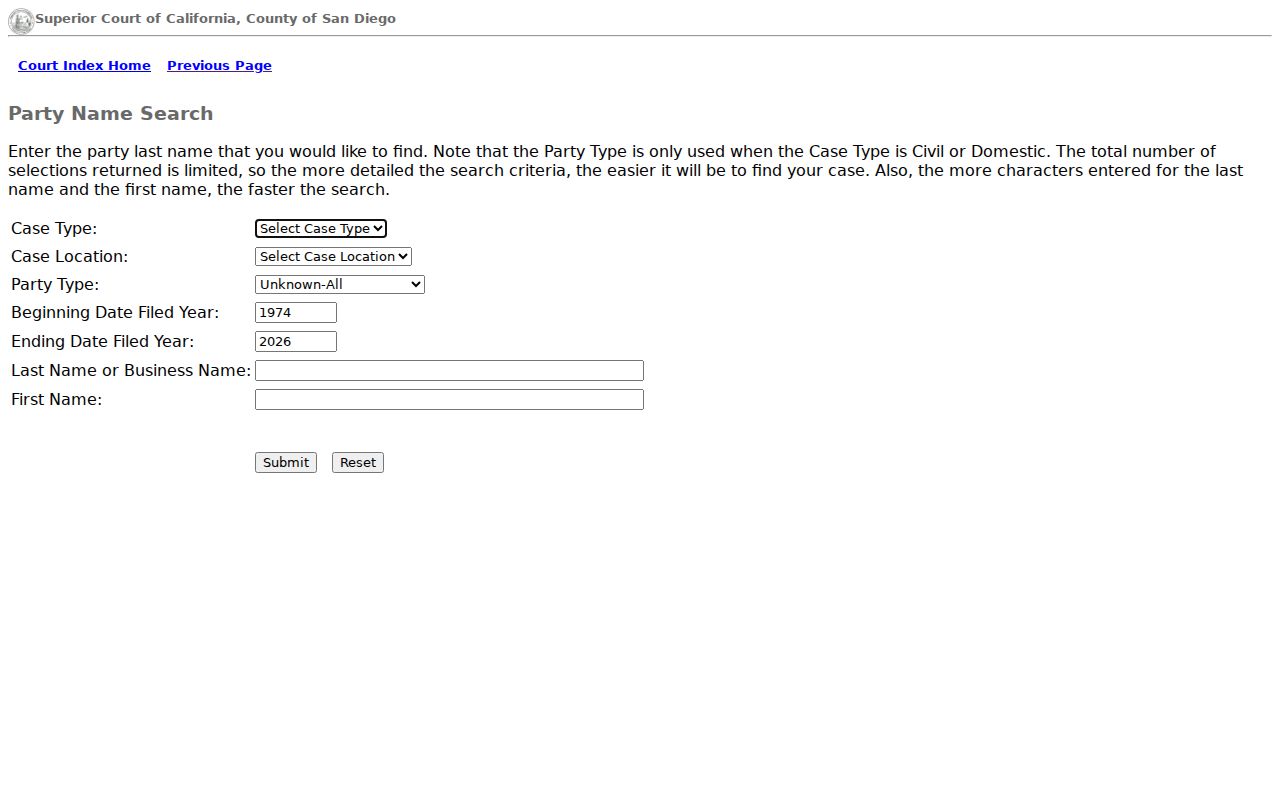
The screenshot shows why a broad surname alone may produce weak matches. Add only verified details, then take the case number to the Register of Actions or the clerk's office.
Registers of Actions list filings, hearings, and eligible document options for many non-confidential cases. Most imaged civil, small claims, and probate matters filed on or after August 24, 2015 may offer a first-page preview and paid download. Criminal documents are not viewed or downloaded online, although eligible copies may be ordered for mailing. Official and certified files require a written or in-person court request. The file remains with the clerk, and California Rule of Court 2.503 limits remote electronic access.
Note: Traffic and minor-offense files are not online, and older civil or criminal cases may require courthouse indexes or microfilm.
San Diego Property Records Geography
A San Diego mailing address does not always identify the right land-record office. The address may fall within the City of San Diego, another incorporated city, or an unincorporated county area. Use SanGIS parcel mapping to search by address, assessor parcel number, or intersection and check jurisdictional layers before requesting permits or code files.
San Diego County routes assessment data through ParcelQuest Lite. Its parcel detail connects an APN to a situs address, property traits, maps, and owner-related data. The San Diego County disclaimer allows a limited number of free searches, while the vendor agreement states different monthly search and map limits, so users should read the live terms before a long project. Certified assessor copies come only from ARCC.
For land inside city limits, Development Services records offer permits and applications from 2003 forward through OpenDSD, Permit Finder, and Accela. Permit Finder holds more than one million permit records and accepts an address, APN, project number, permit number, or approval number. Building records after 1955 use a records-review appointment; the city routes pre-1955 building records to the County Assessor.
San Diego Vital Records Copies
ARCC is the local custodian for births and deaths that occurred in San Diego County and for marriages licensed and registered there. County HHSA handles recent local births and deaths, while California Department of Public Health supplies a statewide route. Full divorce files belong to Superior Court.
The ARCC certificate overview introduces the separate birth, death, and marriage order paths.
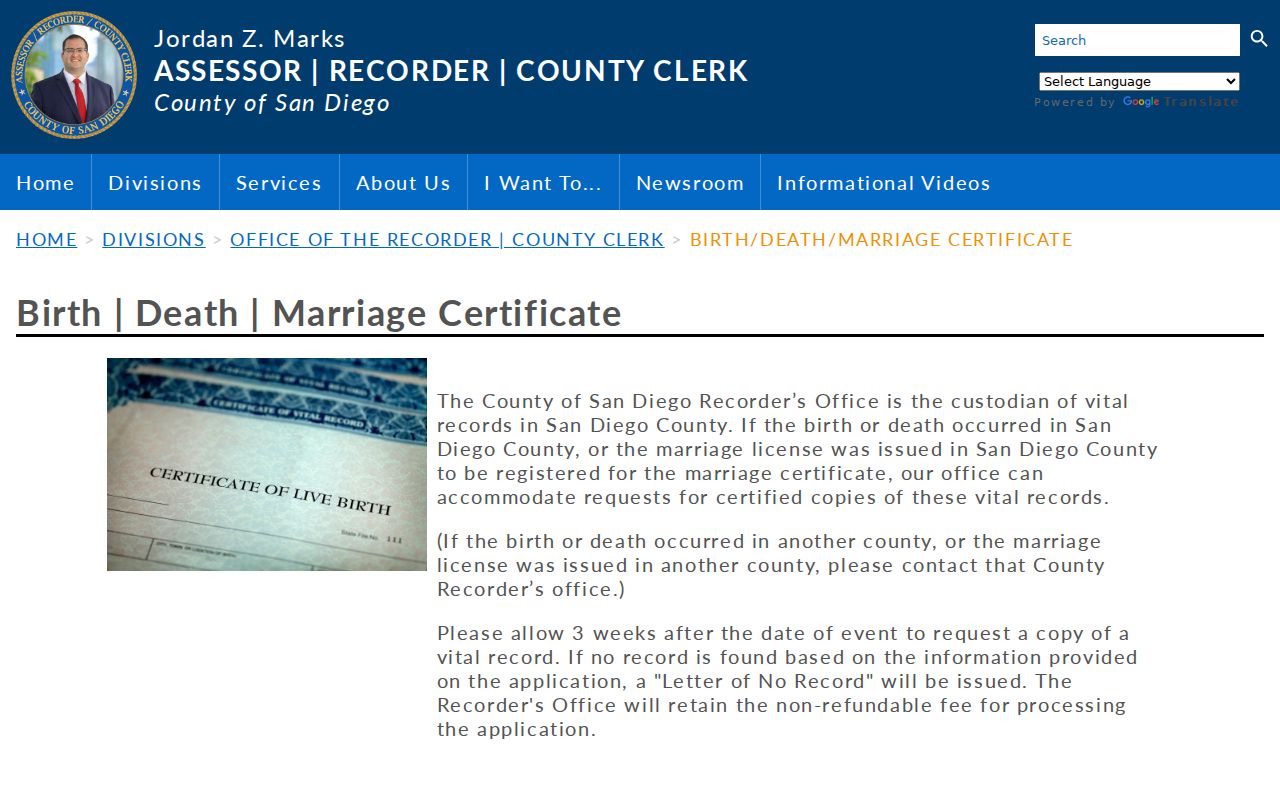
That San Diego division matters because each request uses its own event details, eligibility choice, and form. Local orders may be placed in person, by mail, or online through the county's authorized ordering vendor; CDPH is the statewide fallback. California Health and Safety Code section 103526 reserves an authorized certified copy for eligible people. Other requesters generally receive a certified informational copy marked as invalid for establishing identity. Confidential marriage certificates have tighter limits and generally go only to the parties or a court-authorized requester.
Check the live fee. County ordering pages and the ARCC fee schedule showed conflicting certificate amounts during research, so confirm the current charge before submitting a non-refundable search.
San Diego Public Records Custodians
The San Diego custodian is the office legally responsible for the requested record. Choosing it first avoids sending a court-copy request to a city department or a permit request to the recorder. These three systems cover much of the local access work.
County ARCC Recorder
Deeds, liens, maps, county-clerk filings, and local certificates
Real Estate Records mail: P.O. Box 121750, San Diego, CA 92112-1750
San Diego Superior Court
Civil, criminal, family, probate, mental health, and small claims files
Use the business office where the case was filed for official records
City of San Diego
Department files, correspondence, contracts, and other city records
City Clerk inspection: 202 C Street, weekdays from 8 a.m. to 5 p.m.
San Diego County operates a separate portal for records held by county departments. Police crime reports use the SDPD Records Division process, while traffic collision reports are limited to involved persons. A portal request is not a substitute for a special statutory order form when a custodian provides one.
San Diego Records Fees
Copy costs depend on the legal channel. The ARCC schedule effective July 1, 2025 lists recorded-document copies at $2 for the first page and $0.05 for each added page, with $1 for certification. A certification confirms that a copy matches the custodian's official record. County CPRA rates list $0.30 for a first one-sided paper or scanned page and $0.05 for later one-sided pages. Double-sided first pages cost $0.40.
San Diego city paper copies generally cost $0.25 per page unless another statute sets the price. Electronic records sent through the city portal have no charge. San Diego court downloads and certified copies follow court schedules, and ParcelQuest may charge for reports or use above its free limits. Fees usually cover duplication rather than ordinary search or redaction time, but special records can have their own statutory rates.
Note: Ask for an estimate when a request may produce many pages, and narrow the date range or file type if cost is a concern.
Records California Keeps Closed
Open government law works beside privacy statutes. Juvenile matters, sealed cases, adoption records, protected mental health material, privileged communications, and confidential law-enforcement information are not opened merely because someone submits a broad request. DMV personal data is protected by federal and state law. Current voter data is not a browseable resident list, and protected voters are withheld.
Recorder images can also contain redactions or special restrictions, including limits on military discharge records. Safe at Home substitutes a mailing address for an eligible participant's confidential residence. Courts may show an index entry while withholding the electronic file, and traffic or minor-offense files may have been destroyed under retention schedules.
Use records lawfully. Public access does not permit stalking, threats, harassment, or attempts to defeat a lawful confidentiality program. Respect redactions and official access limits.
Older San Diego Records Offline
Digital cutoffs are not the start of San Diego's record trail. Central Division court indexes reach back to 1880. Volumes from 1880 through 1964 are in hardbound books, with later pre-1974 indexes in computer-generated form. Court staff do not perform microfilm research, so an older case may require a visit to the location where it was tried.
Early county geography adds another twist. Deeds recorded in San Diego County from the mid-1800s may describe land now in Imperial, Inyo, Riverside, or San Bernardino counties because the original county boundaries were far larger. Present-day county lines alone can therefore misroute a historical property search.
When a modern certificate is restricted, probate files, obituaries, and city directories form a practical family-history chain. The San Diego Public Library holds city directories from 1886 through 2021 and obituary microfilm back to 1865. San Diego History Center archives add probate records, coroner inquests, tax lists, deeds, marriage licenses, and court material. These offline sources can identify relatives and heirs without treating a protected certificate as open.
Note: A pre-1970 deed or pre-1974 court matter usually needs an office, archive, library, or historical-repository follow-up.
San Diego Records Terms
Small wording differences explain why a free result may not satisfy an official need. These terms appear across San Diego recorder, court, and agency systems.
- Index
- A finding list with key facts such as names, date, document type, number, or case location. It is not necessarily the record itself.
- Image
- A scan or digital view of the filed document. San Diego recorder images are not available through the online index.
- Certified copy
- A copy formally confirmed by the custodian as matching the official record.
- Custodian
- The office responsible for keeping and responding for a record.
- Exemption
- A law that permits or requires an office to withhold all or part of a record.
Ask for an index result when the goal is to locate a filing. Ask for the image or ordinary copy when the text matters, and request certification only when an official confirmation is required.
Request San Diego Public Records
Any person may make a California Public Records Act request; local agencies do not require California residency. The law requires an agency to decide within 10 days whether it holds disclosable records. Unusual circumstances can add a 14-day extension. That deadline is for the initial determination, not necessarily for final production.
The San Diego County Public Records Request Center lets users search prior requests and submit a new one.
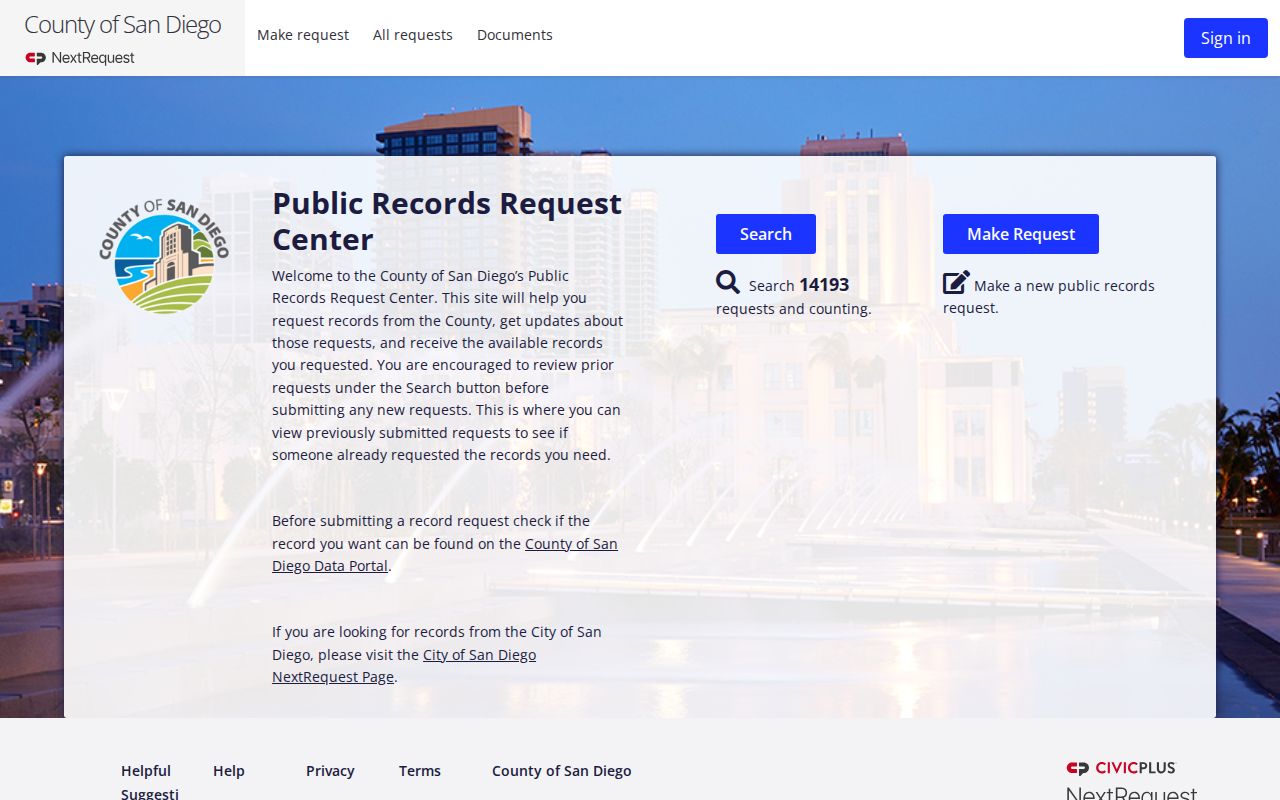
The portal can reveal an existing response before a duplicate request is filed. If no prior result fits, describe the record rather than asking the agency to answer a broad question.
- Identify the San Diego office that created or keeps the record. Use a special court, recorder, police, or vital-record procedure when one exists.
- Search the custodian's index, portal, or published records first. Save the case, document, parcel, permit, or request number.
- State the record type, date range, names, department, and relevant address or number. Avoid vague wording and unexplained abbreviations.
- Choose electronic delivery, inspection, ordinary copy, or certified copy. Ask for a cost estimate when the file may be large.
- If records are withheld, ask the agency to identify the exemption. Narrow an overbroad request or seek legal review of a denial when needed.
City requests may be anonymous, but the city cannot send notices or clarification questions to an anonymous requester. The requester must return to the portal for updates. Request text and communications can themselves become public records, so do not place confidential personal information in a description.